MarginCall Asset Class Tier List
Where a new book should stand, and what to touch later.
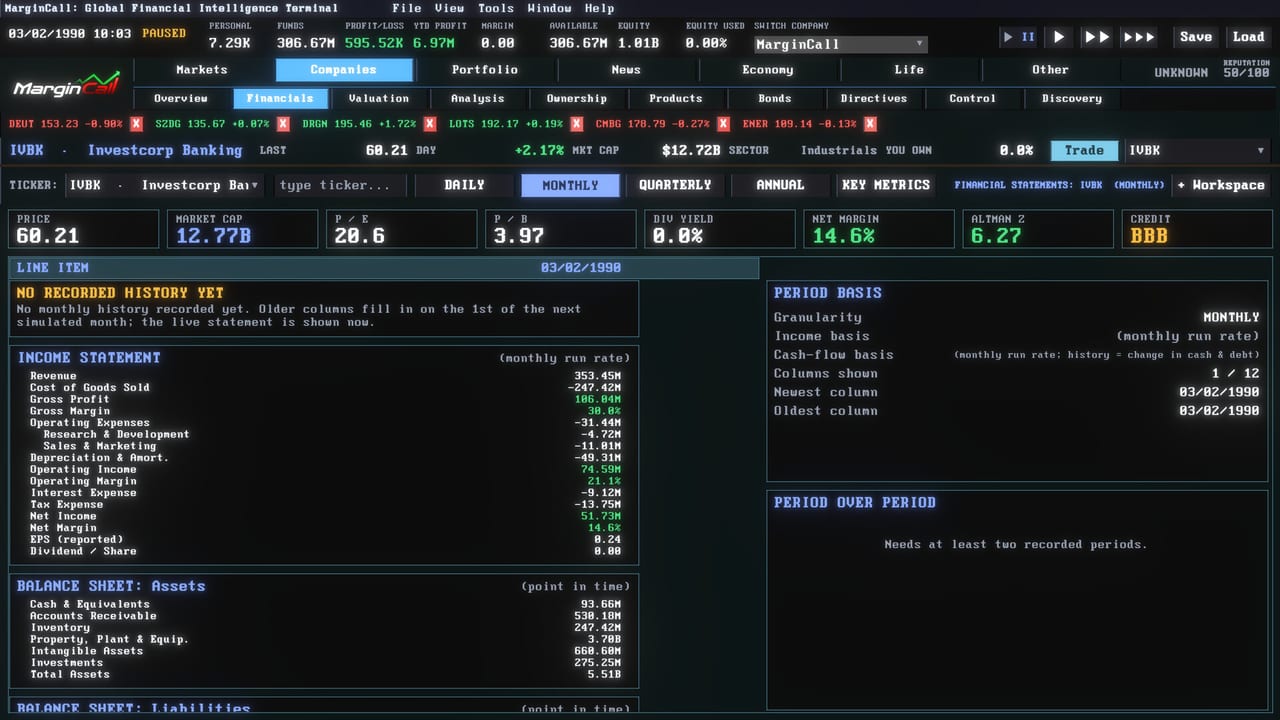
Every asset class in MarginCall sits on the same clock and, where it trades, on real matching. They are not equally polite to beginners. This ranking is for a first save, not for a bored titan. Cross-check Strategy Tiers so you do not put a D-tier instrument under an S-tier plan.
S — Cash equities with a visible book
Listed stocks are the tutorial the game actually wrote. You can see depth, Avail, shorts, and statements. Splits, buybacks, and dividends now behave less like ghosts. Stay here until How to Trade is muscle memory.
Quality government bonds / bills. Carry, duration, and a reason to watch central-bank prints. Early players already used fat yields as a salary. S-tier because they fund Life and taxes while you learn. Not S-tier if you lever them like a meme.
A — Listed companies you might operate
Owning enough of a name to care about factories, data centers, or a CEO title. This is equities plus production plus control. Ranked A because the ceiling is the whole game and the floor is still a stock you can sell if Avail remains.
B — Commodities and FX
Honest, tied to the living economy, easy to overtrade. Affordability checks and less cartoon single-tick violence arrived in Sound Money. Still B because leverage plus a quiet book is how people visit the monitor. Physical delivery on some futures is a feature; it is also a logistics surprise.
C — Crypto as a market
Era-accurate prices are a gift. Mining is a business, not a faucet. Ranked C as a trading vehicle because narratives are loud and power bills are real. Ranked higher if you treat it as a production line with hash, dilution, and tax on sale.
D — Options and high leverage futures for new books
They exist. Chains, expiry, written options you can buy back, futures that settle. Reviewers who live in terminals will live here. New players will find the FEX unfriendly, which is intended. Earnings-print sniping currently inflates the grade; we still park the class in D for first-week accounts because margin plus time decay plus bots-are-slow is a trap with a highlight reel.
If you come to D anyway, cap size with the margin calculator and put the stop in the ticket before the thesis. Then go back to S until boredom is your actual problem, not confusion.
System demand is light (about 1 GB disk, DirectX 11), so performance is not why these ranks exist. Behaviour is. Read patch notes when a class starts printing nonsense; the ladder should follow the code, not the other way around.
A promotion rule
Graduate an instrument only after you can flatten it on purpose. Equities graduate when you can rest a limit and close from the strip. Bonds graduate when you can explain duration with a rate print. Commodities graduate when you can name the chain in the visualiser. Crypto graduates when you can fund power without raiding margin. Options graduate when you can buy a written short back without a panic. Until then the class stays where it is, even if a streamer printed a moon. That rule is how this list stays useful after the first weekend.
Frequently Asked Questions
Direct answers drawn from the same mechanics this wiki covers in depth.
Should I trade options in my first week?
Only on a throwaway save. Learn cash equities and a stop that actually fills first.
Are bonds boring on purpose?
Yes. Boring pays for food and keeps you from 20x-ing a story stock on day one.
Is crypto a good first business?
It can be if you start early in the timeline and fund power. It is a poor first trade if you only chase candles.