How to IPO and Nest Subsidiaries in MarginCall
Listing is financing. Nesting is structure. Neither is free money.
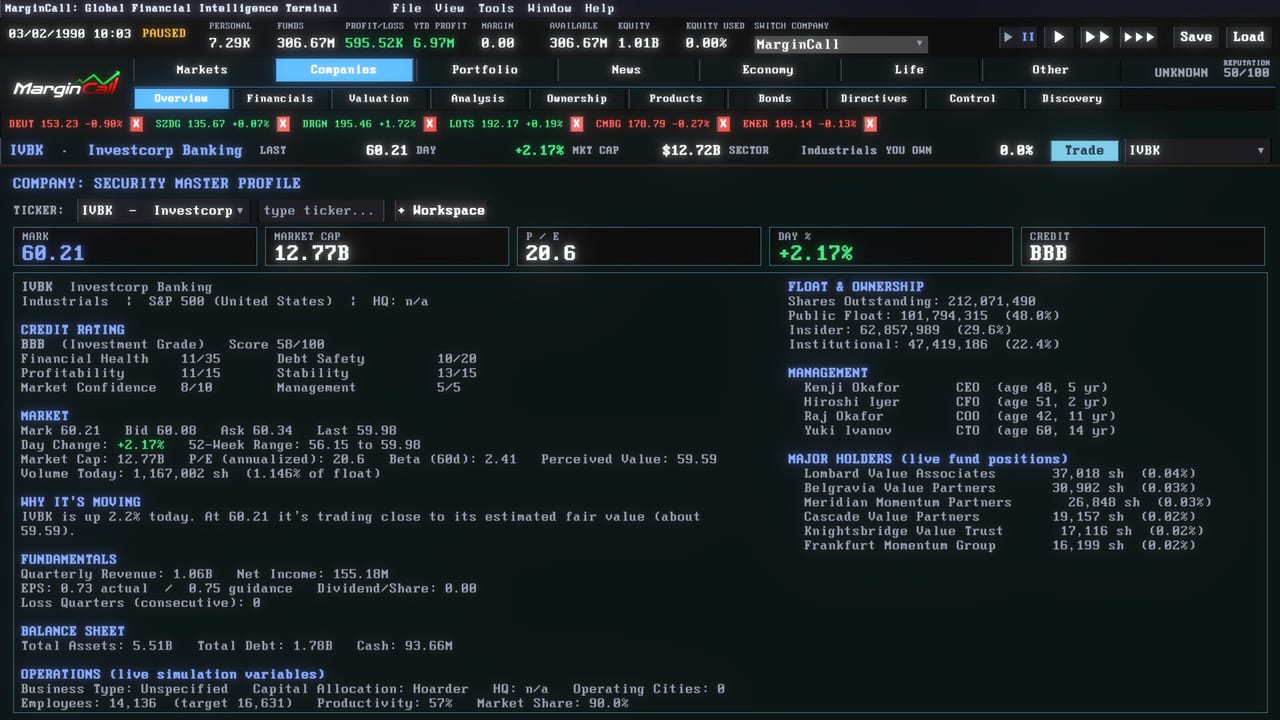
Steam discussions during launch week keep asking the same cluster of questions: how do IPO subsidiaries work, where is company view, and why did listing my firm not double my net worth. This page is the field answer. It sits beside How to Take Over Companies so control campaigns and financing events stay separate in your head.
What an IPO is for in this sim
Taking a company public is a financing and ownership event. You create a tradable float other desks can buy, short, and eventually use against you. Sound Money closed a free-money trick where listing your own company roughly doubled net worth for nothing. If an IPO still looks like a score explosion, look again: dilution, taxes, and a public float that can be cornered or raided are the real outputs.
Use an IPO when you need outside capital, a market price for a unit you intend to run, or a float you can later defend as CEO. Do not use it as a celebration click after a good month in the book. The market will price the shares. You do not get to invent the post-listing number.
Nested subsidiaries after the launch hotfix
Nested subsidiaries arrived with the 19 August hotfix. You can nest a unit under another unit. Seed capital comes from the parent wallet. The entity list indents so the stack is readable. Nest Under Selected is the control. If a parent dies or is liquidated, children reparent safely instead of becoming orphan nonsense.
Rules that protect the maths:
- Ownership can no longer exceed 100 percent, including old buyback inflation bugs.
- Spinoffs are capped at one per company and only fire when the unit would be viable alone, with enough assets, in a different sector.
- Liquidating a subsidiary you operate now closes it for real.
- Merged and liquidated hedge funds leave rankings and get replaced.
Think of nesting as corporate structure with a cash pipe, not as a folder for trophies. Each child is a company you can run: statements, issuance, production, and payroll all matter. SWITCH COMPANY and autonomy levels from the corporate-empire pass are how you stop managing every leaf by hand.
Company view is where the story lives
Company view is the screen Steam threads mean when they say IPO subsidiary and company view in one breath. Open it to see credit rating, float and ownership, volume, EPS versus guidance, dividends, headcount, productivity, and market share. Consolidated group financials roll up the stack. If a nested child is eating cash, you will see it here before the parent wallet goes quiet.
Financial statements were repaired so absurd 3669 percent gross margins no longer print. Typical names sit nearer 45 / 20 / 14 percent gross / operating / net. Monthly views are labelled MONTHLY (est.). Read them with How to Read Financials before you price an IPO or a take-private.
A clean IPO workflow
- Build or buy an operating company that already earns. Listing a hollow shell teaches the float nothing useful.
- Check ownership maths. You cannot own more than 100 percent, and buybacks on a name you control will not inflate you past full ownership.
- Decide whether the unit should stay nested under a parent or list as its own public name. Nesting keeps capital inside the group; listing invites the book.
- Seed from the parent wallet if you nest. Do not raid the treasury like a video-game chest; company-to-personal transfers tax as salary.
- After listing, watch Avail on the new float. A thin float is a squeeze toy for someone else. Combine with How to Short and Squeeze if you are the aggressor, or with defensive buying if you are the CEO.
- Defend the chair. A big enough rival stake can oust you. Activist campaigns keep cooldowns across saves.
Common failure modes
Treating IPO as free net-worth. That exploit is gone. Price the dilution.
Nesting without funding. An empty child still has costs. Seed it, then check company view weekly.
Ignoring the float after listing. Public shares are weapons. Read How to Trade so you do not celebrate 90 percent ownership on a name you cannot exit.
Confusing subsidiary trophies with runnable firms. After the global-markets pass, subsidiaries are companies you operate. If you only wanted a nameplate, you bought the wrong fantasy.
Where to go next
For the ownership climb from Observer toward Consolidated, stay on How to Take Over Companies. For factories feeding the group, open How to Run Production. For a blunt buy/skip verdict and the Wall Street Raider comparison, read the review and MarginCall vs Wall Street Raider. Official patch text that created nesting and killed IPO doubling lives on patch notes.
List when you need capital or a market price. Nest when you need structure. Keep both honest, or the book will teach the difference with your treasury.
Frequently Asked Questions
Direct answers drawn from the same mechanics this wiki covers in depth.
Why did my IPO not double my net worth?
Sound Money removed that free doubling. An IPO is financing and dilution, not a score cheat.
How do nested subsidiaries work?
Nest a unit under another, seed from the parent wallet, and use the indented entity list. Parents reparent children if they die.
Where is company view?
Open the company screens for float, ownership, statements, and consolidated group numbers. Nested children show indented in the entity list.
Can ownership go above 100 percent?
No. The launch hotfix capped ownership and blocked buyback inflation past full control.