How to Read MarginCall Financials
Income, balance sheet, and cash flow now reconcile to one ledger.
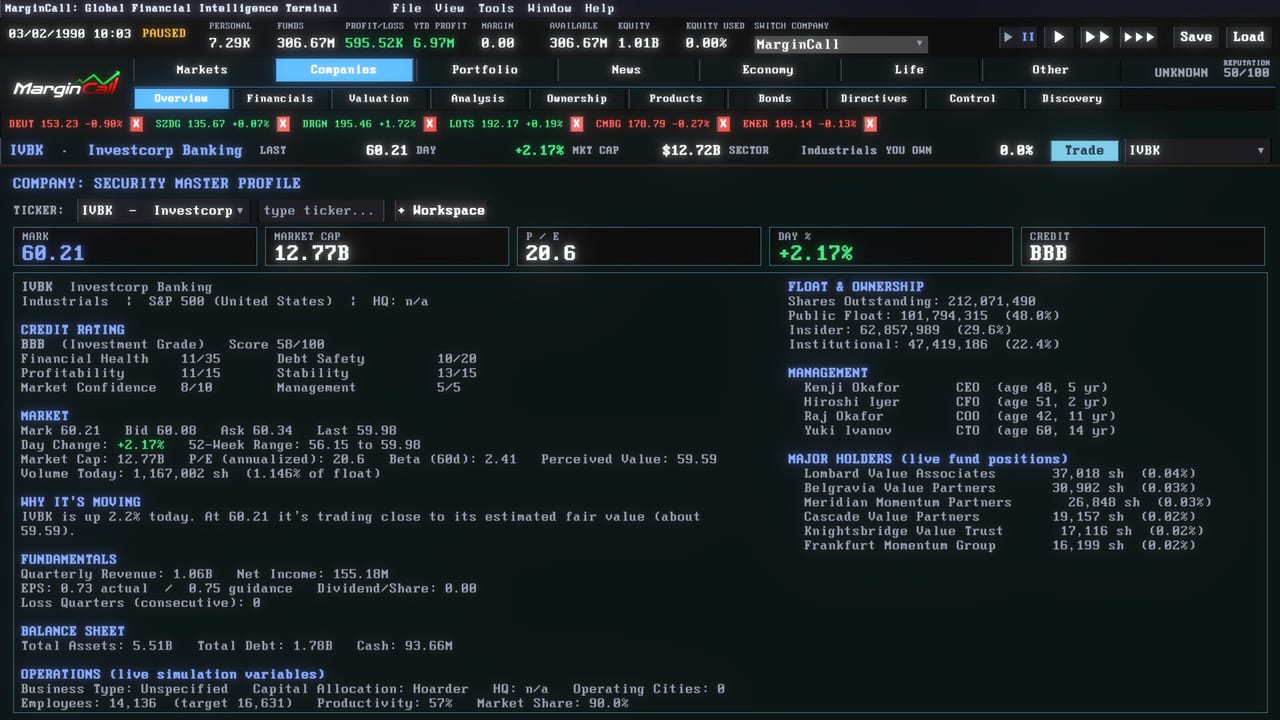
Steam discussions still open threads titled Income screen as if the game hid the numbers. It did, for a while. The 5 August 2026 Financial Reporting and Corporate Empire update put full statements on every listed name: income statement, balance sheet, cash flow, and key ratios, all reconciling to the same ledger. The launch hotfix then stopped those statements from printing 3669 percent gross margins. Typical names sit nearer 45 / 20 / 14 percent gross / operating / net. Monthly views are labelled MONTHLY (est.) because they are the quarterly figure divided by three, not a secret fourth close.
This page is the map for that stack. Pair it with Controls to find the panels, and with How to Take Over Companies when you need consolidated group numbers instead of a single ticker.
Where the numbers live
Open My Company, Financials, Analysis, and Company. Arrow keys step between names on a single-company screen so you can walk a watchlist without hunting the mouse. A company information panel now surfaces data the simulation already tracked: credit rating with a score breakdown, float and ownership (shares outstanding, public float, insider and institutional stakes, and the hedge funds that actually hold the stock), volume, EPS actual versus guidance, dividend per share, headcount, productivity, and market share. If a Steam comment says there is no Income screen, they are probably on the wrong tab, or they bought a future or a fund and are looking at the cash-equity statement.
Positions after the 19 August hotfix show realised P/L, dividends inside that figure and as their own line, plus options and futures. Markets holdings show date acquired and income. If an SMP 500-style product is missing from the portfolio strip, check product type first. That is a known issue pattern, not proof that financials are fake.
How to read a name without inventing a forward P/E
Players asked for forward P/E. Trailing P/E and the four statement views exist. Until a forward multiple ships, do not invent one. Read daily, monthly, quarterly, and annual as four clocks on one ledger. Daily is noisy. Monthly is an estimate. Quarterly is the real reporting pulse. Annual is the story you should be able to retell. Sound Money also made bond yields feed valuation, so a DCF-shaped panel is not a scripted target. If rates jumped, the “cheap” name on last quarter’s earnings may not be cheap on the new discount rate.
Credit rating is a badge with a breakdown, not a vibe. Hedge funds charge a 2-and-20 style management and performance fee against a high-water mark, which matters if you own the fund instead of the stock. Activist campaigns exist for minority stakes; they are pressure, not a magic takeover. HHI on the Economy screen tells you whether a sector is already concentrated before you try to become the concentration.
SWITCH COMPANY and many books at once
The header control SWITCH COMPANY lists your own company first (shown as current even before it lists), then private subsidiaries, then every company you control, sorted alphabetically. Private founded subsidiaries sit beside listed holdings. Autonomy levels run from hands-on management to full AI delegation. Consolidated group financials roll a parent and its subsidiaries into one set of statements. Nested subsidiaries from the launch hotfix indent in the entity list and seed from the parent wallet. If you liquidate a parent, children reparent instead of vanishing into a ghost line.
This is why an Income screen can look empty: you are staring at the wrong entity in the switcher. Confirm the header before you assume the ledger died. Then confirm you did not already post the cash as margin, which Sound Money forbids spending twice.
Earnings season is no longer one tick
The 30 July 2026 Market and Economy Stability update staggered company earnings across the reporting quarter. Every listed name used to print on the same tick four times a year, which lurched the whole market. Reports now arrive on their own schedules. Indices keep a proper divisor, so an IPO, delisting, merger, buyback, or share issue no longer moves the index by itself. Index members mark on a genuine two-sided quote, falling back to the last real trade instead of jumping several percent on a one-sided book with no print.
That matters for anyone who used to lift options the instant a simultaneous earnings bomb hit. Bots can still be slow. That is still not a lifestyle. If you trade the print, know which name is reporting today, not “the market.”
A reading loop that survives
- Identify the entity in SWITCH COMPANY.
- Read income, then cash flow, then the balance sheet. Profit without cash is a story; cash without a balance sheet is a trap.
- Check float and ownership before you size a squeeze or a takeover.
- Write a thesis card with a stop. The terminal will not remember why last quarter’s margin looked like 45 percent.
- If the UI is the blocker, return to Getting Started and place one small fill so Positions proves the product type.
Financials are slow information. The order book is fast information. Use both. A beautiful income line does not pay a margin call.
Frequently Asked Questions
Direct answers drawn from the same mechanics this wiki covers in depth.
Where is the MarginCall Income screen?
Under Financials / Company views. Confirm SWITCH COMPANY is on the right entity, then read income, cash flow, and the balance sheet together.
Why is the monthly statement labelled an estimate?
MONTHLY (est.) is the quarterly figure divided by three. It is not a separate close.
Is there a forward P/E?
Not as of the launch-week notes. Trailing P/E and full statements exist. Do not invent a forward multiple.