MarginCall Review
A fair market that will still spit you out.
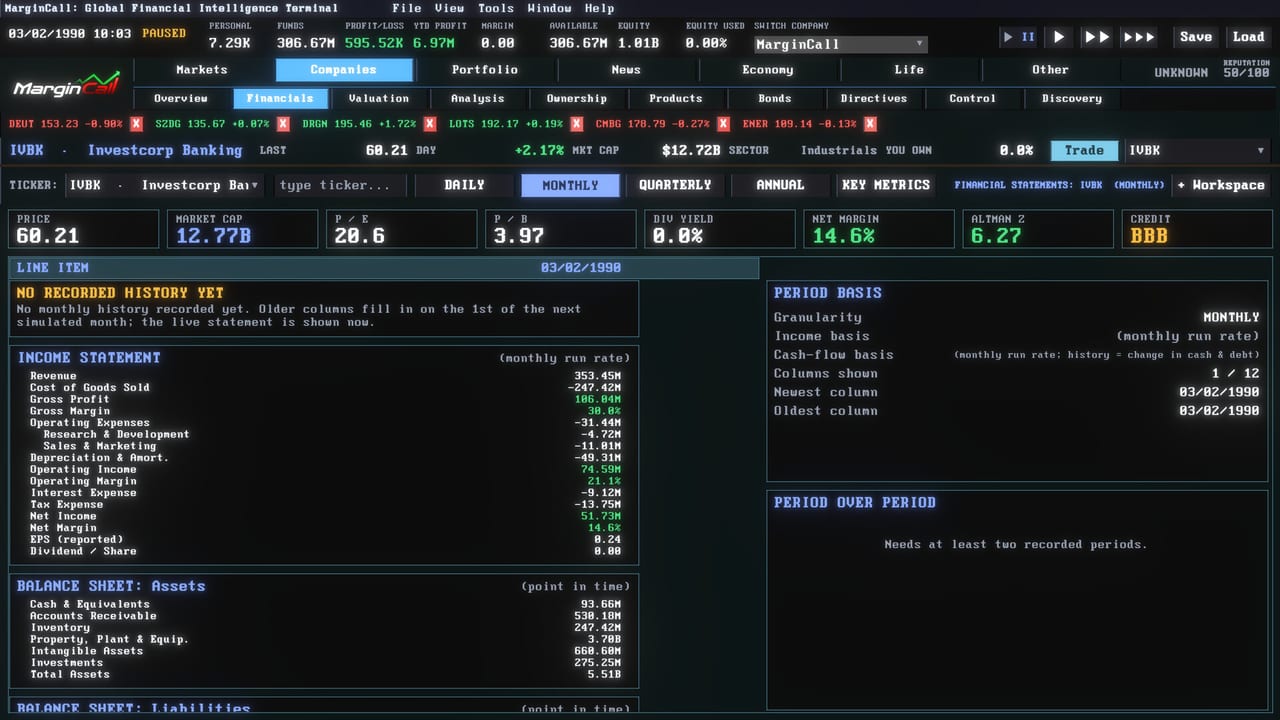
MarginCall launched on Steam on 19 August 2026 at $14.99, with an introductory $11.99 cut through 2 September. Functionally Human published a single-player Windows sim whose store promise is rude and mostly true: prices are discovered on a central limit order book, the economy underneath is simulated, and there is no difficulty slider. Early reviews sat Positive at about 80 percent of a small sample (around forty reviews in the first days). That is a vibe, not a sample size.
This review is for buyers who already know they like dense software, and for buyers who might think a trading game means colourful candles and a win montage.
What it gets right
The book has texture. Spreads exist. Depth vanishes. Market-makers, momentum funds, value desks, and bubble-chasers disagree for reasons, which is why the tape can look stupid without being scripted. When you corner a name, Avail falls and Hard to Borrow appears. That is closer to a real float than most games ever attempt.
Under the tape, production is not a separate minigame poster. Commodities and factories share prices. Data centers eat servers. Crypto mining has an era and a power bill. Sound Money closed several “print money forever” exploits. Digital Frontier made coins and racks behave like objects in time instead of stickers.
The terminal rebuild is the other half of the pitch. Framed panels, headline bands, thesis cards, and a charting suite with studies and drawing tools make the thing feel like a toy Bloomberg, which is exactly what a slice of Steam reviewers wanted. Hover tooltips are generous. If you are willing to read, the game tries to teach.
Life systems (eat, stress, training, taxes, property) keep the run from being a spreadsheet that never blinks. Some players want even more Crusader Kings-style events. What is there already kills accounts that treat the body as optional.
What hurts
It is unfriendly on purpose. Futures and options people say the FEX will spit you out. Players with no market vocabulary get lost in buttons and still call it fun, which is a compliment with a warning attached. You play this run alone. You are alone with desks that do not care.
Launch-week threads are full of ordinary sim pain: graphics bugs, pinned names sliding off-screen, a bought index not showing, TP/SL handles that hide P/L, missing confirmation clicks, questions about whether market orders exist, Income-screen confusion, and wish-lists for a fuller order blotter. Some of that is education. Some of it is software that shipped dense. We keep a running list on known issues. Confirm Windows specs on system requirements before you blame the GPU.
Quant-minded players already want portfolio beta. Fundamental players want forward P/E and deeper books. Both requests are fair. Trailing P/E, statements, DCF-shaped valuation, and macro prints are present; the game currently feels trader-first if you came hoping for a 10-K browser.
An earnings-options exploit (print hits, lift the chain because bots are slow) is already in the wild. That will either get patched or become the meta. Either way it is not the fantasy the store page sold.
Versus Wall Street Raider
People will compare them because both are uncompromising finance sims. The full aisle guide lives on MarginCall vs Wall Street Raider. Short version: Wall Street Raider is a decades-deep corporate-law monster. MarginCall is a CLOB-plus-economy toy with an 80s coat of paint and a production graph you can see. If you want tax-attorney minutiae, you are in the wrong aisle. If you want to feel a book thin out while a factory actually sells chips into a price, you are in the right one. Read How to Take Over Companies, IPO and subsidiaries, and How to Run Production before you decide you need both games.
Who should buy it
Buy it if you like reading panels, writing a thesis, and losing money for a reason you can name. Buy it if STONKS-style arcade markets feel fake. Skip it if you need a campaign director, a friend in the same session, or a fail-safe easy mode. Skip it if you wanted Roblox. This is a PC Steam sim.
If you buy it, start at Getting Started, keep the margin calculator open, and do not 20x the first name you like. The market plays fair. Fair includes tuition.
Frequently Asked Questions
Direct answers drawn from the same mechanics this wiki covers in depth.
Is MarginCall worth buying at launch?
If you want a dense single-player market sim, yes. If you want a gentle tutorial campaign, wait or skip.
Is it like Wall Street Raider?
Same appetite for seriousness, different machine. MarginCall is a live order book plus production. Raider is a deeper legal-corporate sim.
Does it have multiplayer?
No. Steam lists it as single-player.
What should I read after this review?
Getting Started, then How to Trade or the strategy tier list, depending on whether you fear the ticket or the economy first.